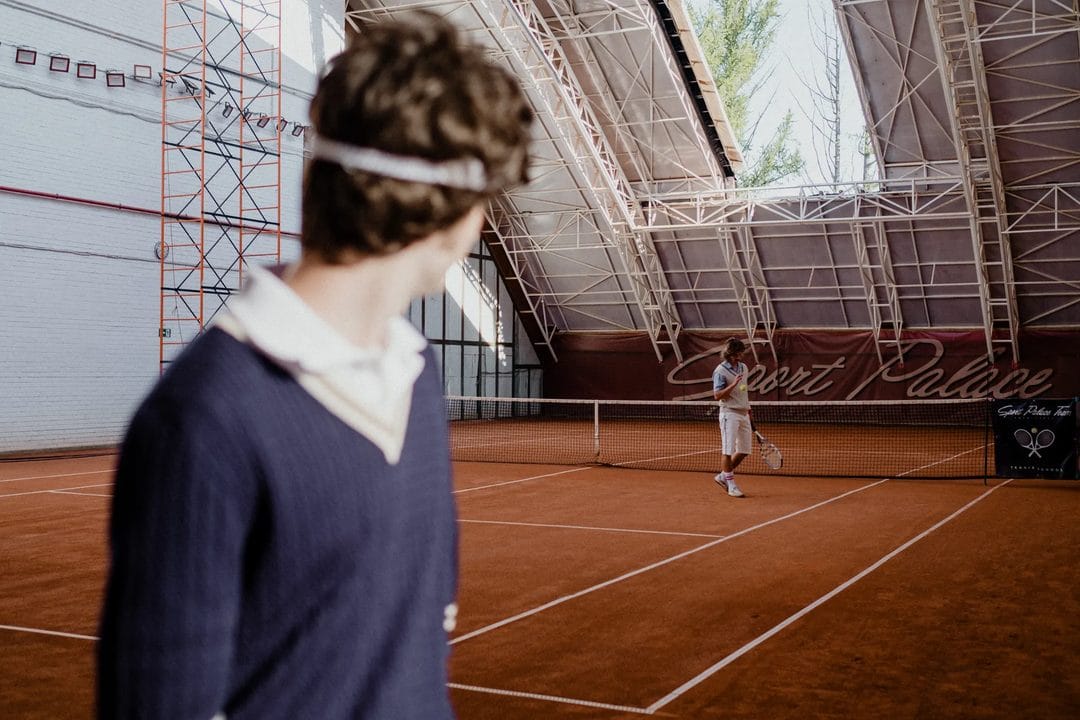
Players who reach the final week of the US Open in late August and early September are running on a surface that generates roughly 30% more impact loading on the knees and hips than grass, according to sports biomechanics research comparing court surfaces published through the International Tennis Federation's technical studies. Flushing Meadows' DecoTurf hard court doesn't give at all on ground contact the way grass does — every step, every hard stop before a passing shot, transmits force straight up through the joint rather than dissipating into a surface that yields slightly underfoot.
That single physical difference reshapes almost everything about how elite players condition for this specific two weeks, and it's why a fitness program built around Wimbledon in July doesn't simply transfer to Flushing Meadows in late August with a few tweaks. The heat is different, the bounce is different, and the joint-loading pattern across a five-set men's match or a three-set women's match is different enough that trainers treat the US Open as its own distinct physical problem, not a hard-court rerun of the same grass-season fitness plan.
The heat and humidity problem grass never created
New York in late August regularly hits mid-90s°F with humidity that pushes the heat index well past 100°F on court — a combination Wimbledon's typically mild, often rain-interrupted July climate rarely produces. The US Open introduced an official heat rule in 2018 allowing a 10-minute break between the second and third sets for women and after the third set for men once the heat stress index crosses a defined threshold, a rule that simply didn't exist in tennis's modern era until hard-court heat forced it into being.
Players training specifically for this surface now build heat-acclimation blocks into their August prep — deliberately training in heated rooms or during the hottest part of the day for 10 to 14 days before the tournament, a protocol borrowed directly from marathon and cycling heat-adaptation research. Core temperature drops measurably faster in athletes who've heat-acclimated this way compared to those who train in air-conditioned facilities right up until tournament week, which is exactly the mistake several lower-ranked players make every single year by training somewhere cooler and comfortable instead.
What changes physically after four rounds on hard courts
- Patellar tendon load accumulates differently than on grass — physiotherapists on tour report more mid-tournament patellar tendinopathy flare-ups at hard-court majors than at Wimbledon
- Lateral movement and the hard-stop-start pattern of a baseline rally punishes the ankles and hips more than grass's naturally sliding, lower-friction surface
- Recovery between matches leans harder on ice baths and compression therapy specifically for the joints, not just the muscles, because the damage profile is more joint-impact than muscle-fatigue
Grass rewards a different physical profile entirely — quick reactions, low center of gravity, comfort with a skidding, unpredictable bounce, and shorter points on average that favor serve-and-volley-style movement patterns. Hard courts reward the player who can survive a grinding, 20-shot rally at 95°F on the fourth Tuesday in a row without their legs giving out before their opponent's does.
The five-set problem for men, and why conditioning peaks differently
A men's best-of-five match at the US Open can run past four hours in extreme heat, and the physical collapse pattern researchers see most often isn't cardiovascular — it's neuromuscular fatigue, where the legs simply stop firing with the same force output late in a fifth set even though heart rate and breathing haven't maxed out. That's a training problem you solve with specific fourth-and-fifth-set simulation work weeks in advance, not with generic endurance running, because the fatigue that actually ends five-set matches is sport-specific in a way a treadmill session doesn't replicate.
Coaches now build practice sets that deliberately run long — three-hour practice matches in the two weeks before the tournament, sometimes in the heat of the day on purpose — specifically to pre-expose the nervous system to the exact fatigue state a real fifth set produces. Novak Djokovic's team has spoken publicly about this kind of late-match simulation work as part of his multi-decade approach to grand slam physical preparation, and it's become standard practice across the top 20 rather than a personal quirk.
Nutrition and hydration built around a different clock
Sodium and fluid protocols shift meaningfully for hard-court heat compared to grass-season tennis. Players commonly increase sodium intake to 1,000-plus mg per hour during matches specifically at hot-weather hard-court events, roughly double a typical grass-court match's requirement, because sweat rates in New York's August humidity run measurably higher than in England's milder July climate.
Here's a detail that surprises even some serious club players: cramping at the US Open is more often a sodium-and-heat problem than a fitness problem, which means a player who cramps in the third set isn't necessarily under-conditioned — they may simply have under-salted their hydration plan for a surface and climate that demands more than their usual routine provides. Teams now test individual players' sweat sodium concentration in training to build genuinely personalized replacement plans rather than relying on generic sports-drink guidelines built for average athletes in average conditions.
Why the surface swap trips up even top-ranked players
Players who dominate Wimbledon don't automatically transfer that form to Flushing Meadows, and the gap between the two skill sets is wider than casual fans assume. The six-week gap between Wimbledon's finish and the US Open's start includes a full hard-court swing through Toronto or Montreal and Cincinnati specifically designed to let players rebuild hard-court-specific movement patterns and joint tolerance before the year's final major — skip that swing, as some top players occasionally do to protect an injury, and the physical readjustment shows up in exactly the kind of early-round upset that surprises television commentators every August.
The single biggest tell that a player has prepared correctly: they're still moving with the same explosiveness in the fourth set of a hot Tuesday afternoon match as they were in the first. Everything else — the serve speed, the shot selection, the mental composure — tends to follow from whether the legs are still firing at full force when the surface, the heat, and the format have all conspired to make sure most players' legs aren't.