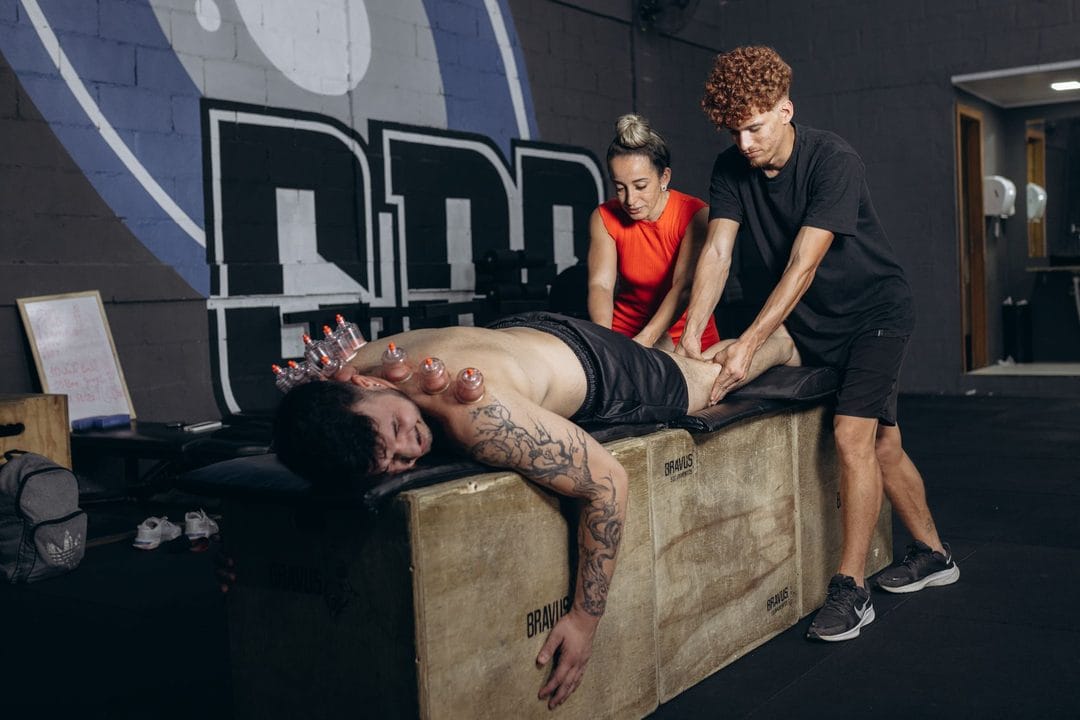
The Recovery Science the Broadcast Never Shows
Every replay of the Champions League final or an NBA Conference Game Seven zooms in on the peak: the sprint, the block, the penalty. What doesn't make the broadcast is the 72-hour window that comes after — ice baths that aren't really ice baths anymore, the sleep-staging data feeding back to the coaching staff before the athlete wakes up, and the blood lactate curves that tell the sports scientist exactly how hard the performance drew down the cellular reserve. That gap between what fans see and what elite performance staff actually measure has closed dramatically since 2022, and it's reshaping how the best teams in the world approach multi-game weeks.
The shift in elite recovery has moved away from passive modalities — the cryotherapy chamber, the contrast bath, the compression boot that used to be the automatic answer — toward active monitoring of what each athlete's body is actually doing. The Dallas Mavericks started publishing fragments of their physiological monitoring approach last year after their sports science director spoke at the NSCA conference, and what emerged was a picture of individualised load management that looks nothing like the old "day off after a back-to-back" formula. Players in the same locker room with the same game minutes logged can have fundamentally different recovery needs based on their travel history, sleep debt, and neuromuscular fatigue state. The performance staff reads all three before deciding the morning-after protocol.
Sleep Architecture Is the Real Marginal Gain
The phrase "marginal gains" has been beaten to death since British Cycling used it to frame the Brailsford era, but there's one domain where it applies with actual precision: sleep staging. Stage 3 slow-wave sleep — the phase where human growth hormone peaks and muscle protein synthesis is highest — is compressed by travel across time zones, by late-night games under high-lux stadium lights, and by the cortisol hangover from a close competition. An athlete who gets eight hours after a home win and six hours of fragmented sleep after a road game in the same week is not getting 75% of their recovery in the latter case. They're getting closer to 40%.
Teams in the English Premier League with travel science units — Liverpool and Manchester City both have them embedded in the performance staff — started timing team meals and light exposure windows around the circadian phase of their players during European campaign weeks as far back as 2023. The approach, originally studied in the context of shift workers and transatlantic pilots, uses the Zeitgeber (time-cue) sensitivity of the suprachiasmatic nucleus to accelerate phase-shifting after a trip from a western European city to a Champions League away tie in Istanbul or Lisbon. It works on a timescale of 36–48 hours rather than the natural 24-hours-per-time-zone pace. The performance edge isn't dramatic in any single game — but over a 10-game European run, the accumulated cognitive sharpness in injury time is measurable.
What the F1 Physiology Teams Know That Team Sport Is Borrowing
Formula 1 has an unusual place in elite sport science: because the performance envelope of the car is so carefully measured, the human element — driver reaction time, neck muscle fatigue, thermoregulation under sustained G-load — gets studied with a precision that most ball-sport teams can't replicate. The Red Bull physiology unit published research in partnership with the University of Exeter in early 2025 on cervical extensor endurance under sustained lateral G, which had direct implications for training protocols ahead of high-speed circuits like Silverstone and Suzuka.
That research is now being adapted, with some necessary modification, by boxing trainers working with elite-level fighters whose chin conditioning is at least as important as their neuromuscular power output. The principle is the same: the cervical stabilisers are a trainable system, they fatigue on a predictable curve, and training them under sport-specific loading patterns — not generic neck bridges — produces durable gains. Don't expect to see this in a mainstream gym program for another three years, but it's already in the training rooms of contenders working under coaches like Eddy Reynoso and Abel Sanchez.
The Tactical Evolution Nobody's Crediting to Sports Science
When Pep Guardiola shifted Manchester City's press trigger from an opponent's goalkeeper reception to an opponent's center-back receiving a switch ball in 2024, it wasn't purely a tactical insight — it was the integration of GPS tracking data showing that City's press units arrived at that specific trigger 0.3 seconds faster than at the previous press trigger, meaning they were converting at a higher rate before defender reaction could adjust. That's sports science informing tactical design in real time, and it's now standard at clubs with dedicated video-analytics-to-pitch-science pipelines.
The NBA equivalent is the pick-and-roll defensive rotation that Phoenix and Oklahoma City both run against ball-dominant guards — a drop coverage with a specific timing cue that the defending big uses to initiate. That timing cue was derived from SportVU tracking data on the dribble-count pattern that precedes the guard's drive decision at above 85% frequency. The coverage doesn't just cover the action; it anticipates it, which is an entirely different defensive proposition. The open mid-range shot that the drop coverage theoretically concedes is, in this design, being given to the specific shooter whose catch-and-shoot conversion rate from 17 feet is below 38%. Giving up a bad shot on purpose is old news in basketball. Knowing with that level of specificity which shot is the bad shot — that's the sports science contribution.
Nutrition Timing in the 90-Minute Window
The post-game nutrition research that emerged from the UEFA Performance & Sports Medicine division across 2024–2025 has produced a fairly clear picture on one long-argued question: the 30-minute anabolic window is real, but it's not as sharp as the supplement industry once claimed, and its importance scales with the game-to-game interval. A player with 72 hours before the next fixture can eat a normal meal within two hours and see no meaningful performance cost in the next game. A player with 48 hours or less — which describes every team in a domestic cup run or a Champions League knockout week — sees measurable muscle glycogen restoration differences between consuming 0.4g/kg of carbohydrate within 30 minutes of final whistle versus waiting 90 minutes.
The practical upshot: the catering operations of elite clubs on back-to-back matchweeks have shifted toward field-side recovery nutrition that doesn't require the player to be in the canteen. Rice cakes, chocolate milk at 1:3 protein-to-carb ratio, and liquid carbohydrate sources that are easy to eat while still in kit have replaced the post-game meal as the first-priority recovery input. The sit-down dinner still happens — but it's the second nutritional hit, not the first. Teams that haven't made this adjustment are leaving measurable glycogen on the table during their most congested fixture weeks.
The Mental Fatigue Variable That Changes Everything
Here's the nuance that doesn't fit neatly into any recovery protocol chart: mental fatigue degrades physical performance in ways that standard load-monitoring misses entirely. A session RPE reading of 6 out of 10 after a tactically complex game under high stakes — a relegation six-pointer, an elimination playoff — represents a different physiological state than a 6 out of 10 after a low-stakes training game. The cognitive load of high-consequence decision-making elevates cortisol and depletes prefrontal dopamine in ways that show up as reduced time-to-exhaustion in subsequent efforts, increased error rate in sport-specific coordination tasks, and elevated injury risk in the 24-hour window after the high-stakes game.
Teams at the forefront — Jurgen Klopp's staff during his Dortmund period pioneered this at the club level, and the insight has since been formalised in the Haaland monitoring protocols at City — now track "cognitive competition load" as a separate variable from physical load. The two don't always move together. A 70-minute run-out in a comfortable 4–0 win reads very differently in cognitive load terms than a 70-minute performance in a penalty shootout. Managing the next session's intensity accordingly isn't softness — it's applied physiology.